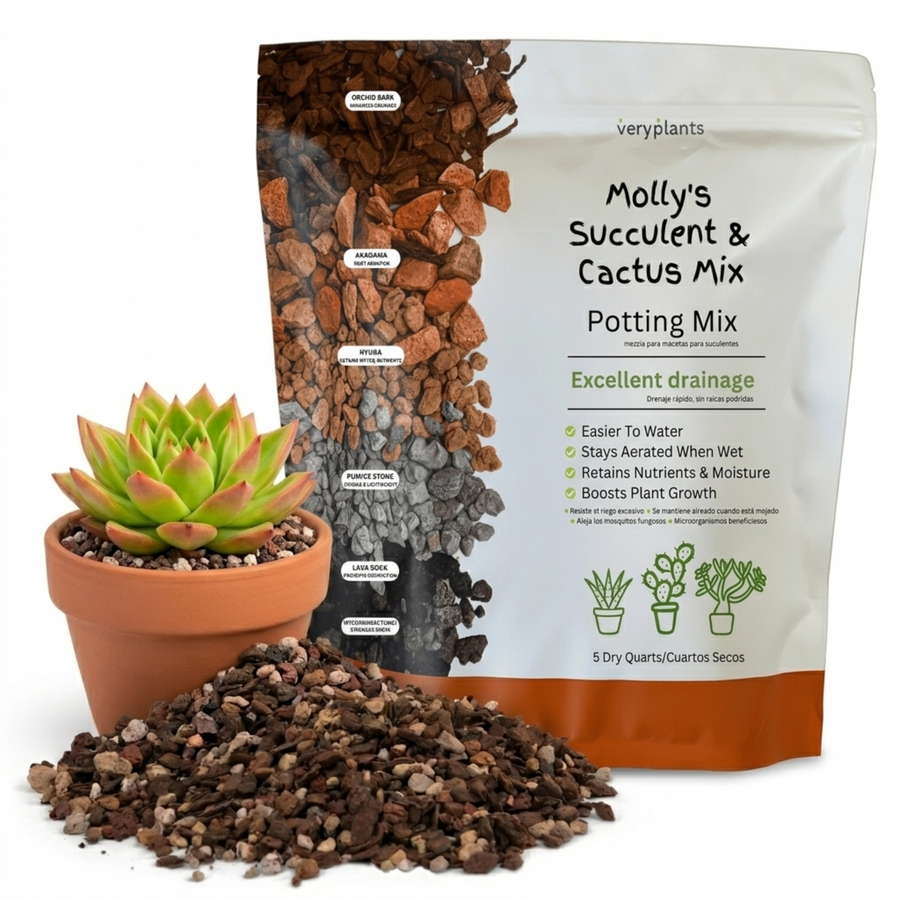
SKU: 88577297331
can you use orchid soil for cactus

can you use orchid soil for cactus Molly's Gritty Mix for Cactus & Bonsai

Sale price$23.56 Regular price$26.18
Save 10%

Pay in installments of $6.54 with ShopPay, AfterPay and Klarna

Shipping Estimate
USA
  • USA
  • CAN

Ships within 48 hours · Estimated delivery Jul 16 - Jul 21

Promo Codes Available:

For Your Every Summer RSVP, with Code: SUMMER15

Description

can you use orchid soil for cactus Molly's Gritty Mix for Cactus & BonsaiQuick answer: what is Molly's Succulent Mix? For: succulents, cacti, bonsai, Haworthia, Echeveria, Sedum, Jade, and any arid environment plant. What's in it: high mineral gritty blend of pumice, lava rock, and crushed bark. Low organic matter by design. Why it works: succulent roots are built to drink fast and dry out fast. The gritty structure drains in seconds and holds zero standing water, so roots don't rot. Pre rinsed and pH balanced straight

Quick answer: what is Molly's Succulent Mix?

  • For: succulents, cacti, bonsai, Haworthia, Echeveria, Sedum, Jade, and any arid-environment plant.
  • What's in it: high-mineral gritty blend of pumice, lava rock, and crushed bark. Low organic matter by design.
  • Why it works: succulent roots are built to drink fast and dry out fast. The gritty structure drains in seconds and holds zero standing water, so roots don't rot.
  • Pre-rinsed and pH-balanced straight from the bag. No salt flush required.
  • Bonsai-safe. The grit profile matches what serious bonsai growers blend by hand from akadama, pumice, and lava.

More plant-specific guidance: Ultimate guide to growing succulents indoors, Potting soil vs potting mix.

Succulents and cacti evolved in arid, mineral-rich environments where water moves through gritty substrate in seconds. Their roots are built to drink fast and dry out fast. Standard potting soil holds moisture for days, suffocates the roots, and rots them from the bottom up. The fix is a high-mineral, low-organic, gritty mix.

Molly's Succulent Mix is engineered to mimic native desert and rocky-slope substrates. A blend of pumice, lava rock, and a small amount of organic matter that drains in seconds and forces the soak-and-dry watering rhythm succulents need.

The gritty-mix philosophy

Most "succulent soil" sold at garden centres is regular potting soil with sand mixed in. That's not what these plants want. The right mix is roughly 70% mineral aggregate (pumice and lava rock) and 30% structural organic (coir, charcoal). Water hits the surface and runs through within seconds. Roots get a brief, intense drink, then dry conditions for the next 1 to 2 weeks. That's how succulents stay alive in pots.

What's in the bag

  • Pumice (volcanic, lightweight): the mineral backbone. Holds a tiny amount of water inside its porous structure, but lets the rest drain freely.
  • Lava rock (red lava): chunky drainage and heat retention. Roots love the warmth differential it creates.
  • Coir fiber (small percentage): just enough organic to retain a little humidity and prevent the mix from drying to a brick. Not enough to compromise drainage.
  • Horticultural charcoal: filters salts from tap water (succulents are surprisingly sensitive to mineral buildup).
  • Calcitic limestone (trace): buffers pH to the slightly alkaline range (6.5 to 7.5) most desert succulents prefer.

Low peat content, no worm castings (succulents don't want a nutrient flush), no commercial fertilizer. The whole mix is intentionally lean.

Plants this is for

Designed for succulents and cacti:

  • Echeveria, Sedum, Crassula (jade), Sempervivum: the classic rosette succulents.
  • Haworthia, Gasteria: they prefer slightly more shade but want the same gritty drainage.
  • Aloe (vera and others): medicinal succulents, this mix prevents the rot they're prone to in heavier soils.
  • Most cacti: Mammillaria, Echinopsis, Opuntia, San Pedro, golden barrel.
  • Lithops (living stones): require fast drainage to stay alive year-round; this mix is well-suited.
  • Bonsai with high drainage needs: juniper, pine, and certain deciduous bonsai work well.
  • Caudex plants: Adenium, Pachypodium, and other swollen-stem species that need fast drainage at the base.

Not for: tropical "succulent-looking" plants like Hoya, Christmas cactus (Schlumbergera), or Easter cactus, which actually prefer humidity-retaining mixes. For those, use Molly's Aroid Mix.

Watering with gritty mix

The right rhythm: soak and dry. Water deeply, then wait until the mix is bone-dry before watering again.

  1. Wait until the top 2 to 3 inches feel completely dry. For most succulents in standard 4 to 6 inch pots, that's every 10 to 21 days indoors.
  2. Water until liquid runs clearly out the drainage holes. Don't dribble. Soak.
  3. Discard any water in the saucer. Do not let the pot sit in standing water.
  4. Wait. The plant will let you know when it's thirsty (slight wrinkling of leaves, lighter pot weight).

In winter, water roughly half as often. Most succulents go dormant or semi-dormant.

FAQ

Why is this so heavy compared to other succulent soil?

Because it's mostly minerals, not peat or coco coir. The weight is what makes it work. Light bag means light drainage, which is the opposite of what succulents need.

Can I use this for bonsai?

For tropical bonsai, no, they want a moisture-retentive aroid-style mix. For drought-tolerant bonsai (juniper, pine, certain deciduous species), yes, this mix or a 50/50 blend with finer organics works well.

Will the mix break down or stay porous over time?

Stays porous. The mineral components (pumice, lava rock, charcoal) don't decompose. The small organic fraction breaks down slowly. Most succulents in this mix can go 2 to 3 years before repotting.

Should I add fertilizer?

Sparingly. Succulents are slow growers and don't need much. A diluted (~1/4 strength) cactus-specific fertilizer once during the growing season (spring) is plenty for most species.

Packaged in a heat-sealed resealable bag. New formula released April 2026, see the formula release announcement for details on what changed.

Related care guide

Watering, light, and repotting fundamentals for succulents and cacti.

→ Read the Succulent & Cactus Care guide

Have questions? Read the Molly's Succulent Mix FAQ for detailed information on watering, repotting, and which succulents this mix works best for.

New: the complete soil guide

Not sure if you need cactus soil or succulent soil? They are the same thing. Read: Best Soil for Succulents and Cactus →

Not sure which mix your plant needs?

Take our free 60-second Soil Finder quiz → Diagnose the problem and get the exact Molly's mix and amount for your plant, plus 10% off.

Shipping Notes
  • Free Standard Shipping on $100+ Orders to the USA.
  • Except Preorder products are shipped in 48 hours.
  • Delivery to the USA:
  1. Standard Shipping : 3-10 business days
  • If time is of the essence, please consider selecting expedited delivery for faster service.
Exchange/Return Notes
  • We offer a 30-day return/exchange service after receiving.
  • Final sale items are not eligible for returns or exchanges.
  • To process your return/exchange, please contact us at [email protected]
  • Please click here for more details>>> Return & Exchange Policy
SKU: 88577297331

Discover Niche Categories That Outsell can you use orchid soil for cactus

Top-Converting Item to Boost Your Average Order

4.5 ★★★★★
Based on 26 reviews
Sort
Highest Rating
Newest First
Oldest First
Product Reviews
J
JeFF Stumpo
Cuba, US
★★★★★ 5
A Feminist Divine Comedy?
Format: Paperback
Let me start with this: The Descent of Alette is difficult to read at first. Notley "puts quotation marks around" "groups of words" "in lines" "that can be off-putting." Note that I'm not quoting from the book there, just giving an example of what the book's text appears like. This forces us to read more slowly, taking in each line a few words at a time. What appears to be awkward is in fact a great solution to the speed-reading most of us do these days. That being said, it's troublesome for the first few poems, less so after that, virtually invisible by the end of the first section. When talking about this book, I immediately compare it to Dante's Divine Comedy, and I commonly see others do the same (see an earlier review here on Amazon.com). Exchange Hell for a subway, and you've basically got it: an underground realm ruled over by a Tyrant, poor souls being tortured, though in this case there is no indication that they have done anything to deserve it. Notley's language might not be quite as beautiful/harsh as Dante's, but her images stand with anything he created. After introducing two characters on a subway, a woman and her baby, both on fire, Notley writes: "another woman" "in uniform" "from above ground" "entered" "the train" "She was fireproof" "she wore gloves, & she" "took" "the baby" "took the baby" "away from the" "mother" "Extracted" "the burning baby" "From the fire" "they made together" "But the baby" "still burned" ("But not yours" "It didn't happen" "to you") "We don't know yet" "if it will" "stop burning," "said the uniformed" "woman" "The burning woman" "was crying" "she made a form" "in her mind" "an imaginary" "form" "to settle" "in her arms where" "the baby" "had been" "We saw her fiery arms" "cradle the air" "She cradled air" ("They take your children" "away" "if you"re on fire") "In the air that" "she cradled" "it seemed to us there" "floated" "a flower-like" "a red flower" "its petals" "curling flames" "She cradled" "seemed to cradle" "the burning flower of" "herself gone" "her life" ("She saw" "whatever she saw, but what we saw" "was that flower") After surviving the horrors of the subway, Alette goes even deeper underground, passing through a series of psychological challenges that at times seem straight out of Freud, at times out of Classical mythology, at times out of collective dreams. Throughout it all, we learn more and more about Alette, who is not just a "hero" who goes through the motions necessary to the plot, but who considers and stumbles and is confused and learns. The third section of the book is a rebirth, wherein Alette finds a source for a stronger power than the Tyrant's, and it is distinctly feminist in its nature. I need to note here for those who react to feminism in a knee-jerk way: Notley's feminism is not a militant feminism, though it requires brief "military" action on Alette's part. Men are helpful in the story, have purpose besides being the bad guy. If anything, what Notley attacks in the form of the Tyrant is the idea of a corrupt masculinity, a kind of Big Brother who would easily stand as an antagonist in any number of 20th/21st century literary works. Alette's feminism is the discovery of her place in the world, and that place is not slaving away mindlessly for the Tyrant, not acting as just a womb or pair of hands or pretty face. It's a nuanced message, despite the epic (and therefore presumably black-and-white) nature of the whole book. The fourth section is the showdown with the Tyrant, a great deal of philosophizing, and an ending that I actually find more satisfying than that of Paradiso. I won't spoil it here, but it just works extremely well in conjunction with the themes of Descent as a whole. If you want to be challenged, if you want to think deep thoughts, if you want surreality and magic, pick up The Descent of Alette. For even more interesting reading from the author and her partner, you could also turn to The Scarlet Cabinet, which contains but actually predates the on-its-own publication of Descent.
WAS THIS REVIEW HELPFUL?YesReportShare
Reviewed in the United States on October 11, 2010
K
Kent Shaw
Bozeman, US
★★★★★ 5
A Contemporary Epic
Format: Paperback
I have a complicated relationship with most of the books I've read by Alice Notley. I admire her facility with the lyric, her ability to get just beneath a concept or sentiment using a very talk-y style so that I always feel like I'm with whatever speaker she's using, inside that mind and her mind all at once. This is a good kind of complication. It's one I yearn for with poems. The unpleasant complications are when I feel as though I'm just being subjected to her unedited notebook entries. Too much, too much, too much. It comes up especially with her book Mysteries of Small Houses. I mention these difficulties only to sharpen the accomplishment of The Descent of Alette. Like other reviewers, I feel the tonal similarities to Dante's Inferno. Which becomes a subversive allusion considering Alette seeks after a male Tyrant in order to destroy him, while Dante sought after his Beatrice out of desire. But I read and reread Alette, because Notley continually subverts patriarchal conventions in the book. I actually find I crave the speaker's intellect, and the mythic logic that gives the book its arc. I want it more. Yes, there are quotations around each fragment in the poems. I actually appreciate them for slowing my reading down, and for sharpening my focus on the use of Notley's language. And it's not just a stylistic tic, or something to be endured. It could actually be described as further subversion of The Tyrant Alette pursues.
WAS THIS REVIEW HELPFUL?YesReportShare
Reviewed in the United States on August 25, 2011
R
Verified Purchase
Raquel Wilbon
Lake Worth, US
★★★★★ 2
Imagery and diction
Format: Paperback
This book was very challenging to read because everything was written in quotations however, it was intriguing as a different way of writing poetry.
WAS THIS REVIEW HELPFUL?YesReportShare
Reviewed in the United States on August 11, 2020
A
Verified Purchase
amber a
Draper, US
★★★★★ 5
I tend to leave most books in this genre disappointed. I miss the classics
Format: Hardcover
I bought this book after hearing Stacey Lee speak about narrative tension at a lecture for YA writers - the talk was specifically entitled, "How to keep them up all night." The lecture (alongside Anna Shinoda) bit off a rather large amount of material. Neither woman mentioned vampires. The methods they discussed were smart, creative, and delivered with just enough humor to leave me wondering whether I'd be able to put their debut novels down. I devoured GONE WITH THE WIND at least six times cover to cover between my sophomore and senior year. While I am more susceptible to the Historical Fiction page turner than the average girl, I tend to leave most books in this genre disappointed. I miss the classics. I opened this book determined to not judge it by its gorgeous pastel cover. I started slowly. I enjoyed the first four or five chapters - leaving each fully appreciative of Lee's craft. I particularly enjoyed her ability to pepper humor though tragedy. I often complain about writers who miss the mark here. Stacey Lee nailed that important believable balance for me. I liked her characters quickly. I left each chapter satisfied, but thoroughly able to get up and go on with my life. Like a jaded Thumper in Walt Disney's BAMBI, this book was more than nice, but I wasn't susceptible to any kind of teen-aged Twitterpation over it. After the sixth or seventh chapter - four or five days after I first picked it up, I quietly closed my copy, placed it on my nightstand, switched off my lamp, fluffed my pillow and turned over. I turned over again. I flipped on the light - OK, just one more chapter... I zombie sleepwalked to work the next day. That night I retired early, making some completely convincing excuse about being exhausted. I was certainly too tired to read. Flash forward to 6AM when I woke up with this novel on my face. I turned it's last page this afternoon, fully satisfied. I am truly sad it's over. This book transported me. It's one I'll want to have in my collection forever, alongside the beautiful books that mattered to me as a teen; JANE EYRE, TO KILL A MOCKINGBIRD, UNDER A PAINTED SKY. Classic in feel, subject matter, and voice - but modern in approach, I'd be as comfortable recommending it to my book club as I would handing it to any teen. Readers of all ages and walks of life will surely find something that resonates with their own stories too. As for me, I am sure I'll be back on the trail with these girls-- I mean boys, before long. Now I'm off to try my hand at Anna Shinoda's LEARNING NOT TO DROWN. Well, maybe tomorrow. I need a good night's sleep and it's clear these authors know how to keep those pages turning.
WAS THIS REVIEW HELPFUL?YesReportShare
Reviewed in the United States on August 24, 2015
R
Verified Purchase
Ruth Franklin
Belleville, US
★★★★★ 4
Good, Fun, Important Topics
Format: Paperback
Good, solid, read for ages 12+. Somewhat unrealistic and yet believable story of two strong young female characters traveling west disguised as boys. Couldn't stop reading it until I was finished with the book, and now my granddaughter is doing the same. This book has many relevant themes about race, gender, class, religion, and other stereotypes and is an excellent choice for a classroom or family read aloud. Get it.
WAS THIS REVIEW HELPFUL?YesReportShare
Reviewed in the United States on February 26, 2017

recommand products